
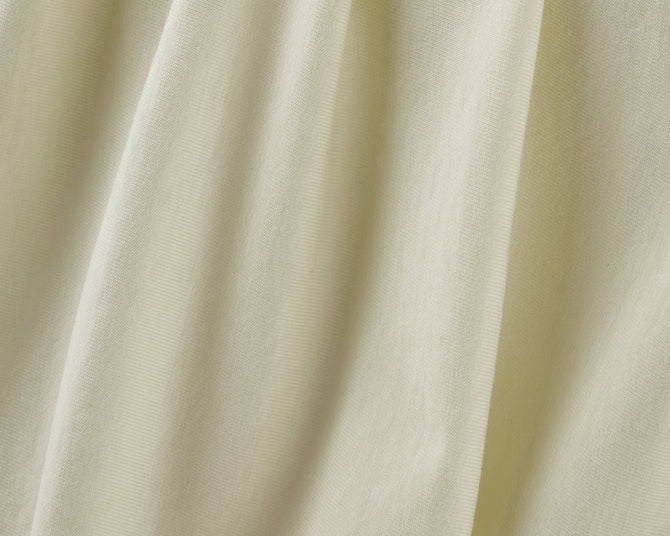




For decades, cupro has been valued as a lining material in premium clothing. Its smooth surface, subtle luster, and fluid drape make it particularly suitable for tailored garments, where comfort and ease of movement matter as much as appearance.
Yet cupro has a place beyond the inside of a jacket.
French fashion house LEMAIRE, for example, uses a blend of 76% cupro and 24% polyamide in its Drape Shirt in Shiny Cupro. The fabric's sheen and fluidity contribute to the shirt's relaxed silhouette, making the material itself an important part of the design.
Cupro has also found its way into contemporary knitted garments. COS ATELIER explored its potential in The Knitted Bolero Sleeves, made from 75% cupro and 25% silk. The delicate knit creates a lightweight, softly translucent appearance.
These examples reveal a broader range of possibilities for a fiber traditionally associated with linings. Beyond its silky hand feel, cupro can contribute to the texture, appearance, and character of modern apparel.
But what exactly is cupro, and what happens when it is blended with fibers such as lyocell and linen in knit fabric development?
What Is Cupro Fabric?
Cupro is a regenerated cellulosic fiber made from cotton linters—the fine, short fibers that remain attached to cotton seeds after the longer cotton fibers have been removed.
Unlike conventional cotton, which is spun directly from naturally occurring fibers, cupro is produced by dissolving purified cellulose in a copper-ammonia solution and regenerating it through a spinning process.
The result is a manufactured cellulosic fiber with a notably fine, smooth texture.
One of the best-known examples is Bemberg™, the cupro fiber brand developed by Japanese manufacturer Asahi Kasei. Long established in premium garment linings, Bemberg has also been used in outerwear, innerwear, and other textile applications.
Although cupro originates from plant-based cellulose, it should not be confused with natural cotton or silk. Its properties result from both the cellulose raw material and the fiber manufacturing process.
Why Is Cupro Used in Premium Apparel?
Cupro is often described as silk-like, particularly because of its smooth hand feel, gentle luster, and fluid movement.
However, cupro and silk are fundamentally different fibers. Silk is a natural protein fiber, while cupro is regenerated cellulose. Their performance, care requirements, and behavior in finished fabrics are not necessarily the same.
Cupro's appeal comes from a combination of qualities that can be useful in different garment applications.
A Smooth, Refined Hand Feel
Cupro is especially appreciated for its soft and smooth surface.
In traditional linings, this helps garments slide comfortably over other layers. For clothing worn directly against the skin, a similarly refined touch can contribute to a pleasant wearing experience.
This makes cupro an interesting option for shirts, lightweight tops, and garments where tactile comfort is central to the design.
Subtle Luster and Fluid Drape
The appearance of cupro can be just as important as its touch.
Its gentle sheen and fluid drape lend themselves to garments that emphasize movement rather than rigid structure.
The LEMAIRE shirt illustrates this particularly well. Rather than relying on elaborate surface decoration, the design uses the material's fluid character to shape its silhouette.
Moisture Absorption and Comfort
As a regenerated cellulosic fiber, cupro can absorb and release moisture, contributing to comfort in garments worn close to the body.
However, moisture absorption should not be confused with quick drying. The drying behavior of a finished fabric depends on its complete construction, including yarn selection, fabric weight, density, and finishing.
For apparel developers, these distinctions matter. A fiber's inherent properties provide a starting point, but the final fabric must still be evaluated against the intended garment requirements.
Why Blend Cupro with Lyocell and Linen?
Cupro has distinctive properties on its own, but using it in a blend opens up different possibilities for fabric development.
Consider a spring/summer knit top. The fabric may need to feel soft against the skin while maintaining a natural, slightly textured appearance. It may also require enough stretch to support a fitted silhouette without sacrificing comfort.
Rather than expecting one fiber to deliver every characteristic, developers can combine materials with complementary qualities.
A blend of cupro, lyocell, linen, and elastane offers one approach.
| Fiber | Typical Characteristics | Role in Blend Development |
|---|---|---|
| Cupro | Smooth touch, subtle luster, fluid character | Adds a refined, silk-like tactile quality |
| Lyocell | Softness, moisture absorption, comfortable hand feel | Provides a soft and comfortable foundation |
| Linen | Natural texture, distinctive fiber character, relatively crisp touch | Introduces linen texture and a drier tactile character |
| Elastane | High extensibility and elastic recovery | Supports stretch and flexibility in the knit |
These materials do not act independently. Their proportions, yarn structures, and interaction within the fabric all influence the finished result.
For example, a lyocell-rich knit can already offer a soft, comfortable feel. Introducing cupro and linen creates an opportunity to develop a different tactile profile—one that combines smoothness with a more natural, textured character.
The result does not have to resemble either a conventional lyocell jersey or a traditional linen fabric.
This is particularly relevant for brands developing elevated everyday essentials. A simple T-shirt, fitted top, or dress can gain a more distinctive material identity through fiber selection, even when the garment design itself remains minimal.
From Fiber Blends to Modern Knit Fabrics
Choosing the right fibers is only the beginning.
When cupro, lyocell, and linen are developed into knitted fabrics, yarn design, coloration, fabric construction, and finishing all contribute to the final appearance and wearing experience.
Creating Depth Through Yarn and Color
Not every distinctive fabric needs an obvious pattern or decorative finish.
Differences in fiber texture, surface character, and coloration can create subtle visual variation within a fabric.
Through multi-fiber yarn development and carefully controlled coloration, cupro-linen-lyocell blends can achieve a heathered appearance with fine variations in tone and texture.
This adds visual depth without overwhelming the simplicity of the garment.
For contemporary casualwear and premium basics, such details can be particularly valuable. They allow brands to differentiate familiar silhouettes through the material itself.
Working with multiple fibers also introduces technical considerations. Different dyeing behaviors must be managed carefully to achieve the intended appearance, colorfastness, and consistency between production batches.
How Knit Construction Changes the Result
Even when fabrics share a similar fiber composition, they can behave quite differently depending on their knitted structure.
Single Jersey provides a relatively simple, flexible construction that can be developed into lightweight and comfortable everyday tops.
1×1 Rib and 2×2 Rib introduce more pronounced surface texture and characteristic crosswise stretch. When combined with elastane, these constructions offer opportunities to adjust stretch, fit, and garment shape.
Fabric weight adds another consideration.
A lighter jersey may suit a relaxed summer top, while a heavier rib construction may be better suited to a fitted garment that requires more substance and stretch.
There is no universally superior option. The right choice depends on the intended silhouette, desired hand feel, and performance requirements.
For fabric developers, evaluating the blend therefore means looking beyond the composition label. Stretch recovery, dimensional stability, surface appearance, and colorfastness should all be considered during sampling.
Exploring Regen-tech's Cupro-Linen-Lyocell Knit Fabrics
At Regen-tech Fashion, we have developed a selection of cupro-linen-lyocell knit fabrics for contemporary spring/summer apparel.
The collection brings together the smooth tactile character of cupro, the softness of lyocell, and the natural texture of linen, with elastane incorporated for added stretch.
Rather than focusing on a single fiber, these developments explore how different compositions, fabric weights, and knit constructions can support a range of garment styles.
| Fabric | Composition | Weight | Construction |
|---|---|---|---|
| 6598 | 74.8% Lyocell, 9.4% Linen, 9.4% Cupro, 6.4% Elastane | 240 GSM | 2×2 Rib |
| 6618 | 72.9% Lyocell, 11.1% Elastane, 8.9% Cupro, 7.1% Linen | 220 GSM | 1×1 Rib |
| 26D081 | 75.2% Lyocell, 9.2% Cupro, 8.3% Elastane, 7.3% Linen | 160 GSM | Single Jersey |
Fabric 6598 combines a lyocell-rich composition with equal proportions of cupro and linen. Its 240 GSM, 2×2 rib construction creates a more substantial knit with a textured surface and stretch, making it a candidate for fitted tops, tanks, and dresses.
Fabric 6618 explores a 1×1 rib construction at 220 GSM. With a higher elastane proportion, it provides another option for brands developing stretch-oriented tops that balance a refined hand feel with flexibility.
For lighter-weight applications, 26D081 uses a 160 GSM single jersey construction. It offers a different starting point for spring/summer T-shirts, tanks, and everyday tops where a lighter fabric is preferred.
Across these developments, the emphasis is not simply on adding cupro as a premium ingredient. It is on creating a balanced fabric in which fiber selection, yarn development, and knit construction work together to achieve a specific appearance and wearing experience.
Beyond Silky Comfort
Cupro's journey from cotton linters to premium garment linings is already an interesting material story. Its use in modern apparel shows that the fiber has possibilities beyond its traditional role.
For knit fabric development, the opportunity becomes even more interesting when cupro is combined with other fibers.
Blending it with lyocell and linen allows designers to explore the relationship between silky smoothness, natural texture, softness, and stretch—qualities that can bring a different character to familiar spring/summer garments.
At Regen-tech Fashion, we continue to explore these material combinations through yarn development and knitted fabric construction, creating options for brands looking to differentiate their collections through touch, texture, and comfort.
Interested in developing with cupro-blend knit fabrics? Contact our team to explore available fabric qualities, request swatches, or discuss your next collection.