
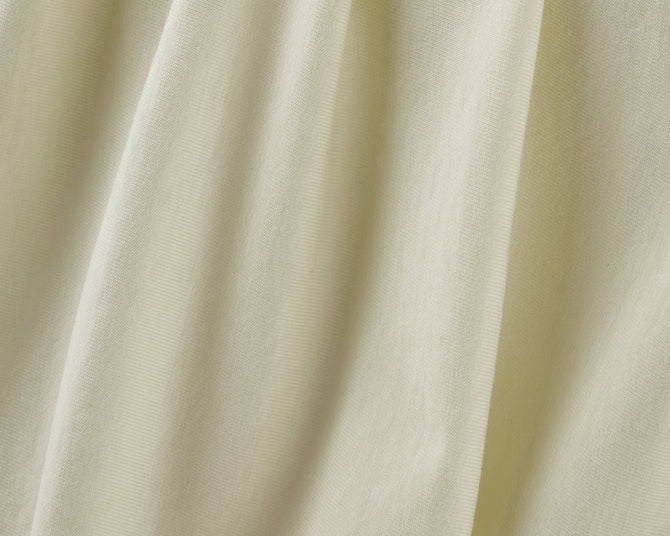




A boxy sweatshirt needs enough body to hold its shape without feeling stiff. Winter trousers may call for a softer, wool-like surface while maintaining a clean, structured silhouette.
Both designs require a balance of comfort, fabric weight, surface texture, and structural support. Yet they can achieve that balance through very different fabric constructions.
Double knit and bonded knit fabrics offer two ways to approach these requirements. One develops structure through knitting, while the other combines separate fabric layers through a bonding process.
Understanding how these approaches work helps apparel designers and sourcing teams choose fabrics for sweatshirts, relaxed trousers, and contemporary matching sets.
Double Knit vs. Bonded Knit: What's the Difference?
Although both constructions can produce fabrics with substantial body and a structured appearance, the methods behind them are different.
Double Knit: Structure Created During Knitting
Double-knit fabrics are produced using two sets of needles, allowing different stitch arrangements to form a connected knitted structure.

Compared with many single-jersey constructions, double knits can offer greater thickness, dimensional stability, and resistance to edge curling. Their exact properties depend on the yarns, stitch arrangement, density, and finishing.
Scuba-style double knits are one example. Through engineered knit structures, they can create a smooth surface, a fuller handfeel, and a degree of stretch without necessarily relying on elastane.
However, not all double knits behave alike. A lightweight interlock and a substantial scuba knit may have very different drape, stretch, and garment applications.
Bonded Knit: Structure Created by Combining Layers
Bonded fabrics are made by joining separately produced material layers, often using adhesives.
For a bonded knit, the face fabric and backing can be selected for different purposes.
The face may be developed for visual texture and handfeel, while the backing contributes to the overall structure, stretch behavior, or stability of the finished composite.
This approach creates opportunities to combine materials and finishes that would be difficult to achieve through a single knitted construction alone.
The distinction is important: double knit describes how a fabric is knitted, while bonded knit describes how material layers are joined. A double-knit fabric can also undergo bonding as an additional process.
Scuba Double Knit for Boxy Sweatshirts and Relaxed Silhouettes
A boxy sweatshirt is a useful example of how fabric construction influences garment shape.
The design typically features a relaxed body, dropped shoulders, and a relatively defined silhouette. If the fabric is too fluid, the garment may lose some of its intended volume. If it is excessively rigid, the sweatshirt may feel uncomfortable during movement.
A substantial scuba double knit can provide a useful middle ground.
Fabric Example: Regen-tech 6307 Scuba Double Knit
- Composition: 63.1% Cotton / 36.9% Polyester
- Weight: 320 GSM
- Construction: Double Knit
- Elastane: None
6307 uses an engineered double-knit construction designed to deliver a soft, cotton-like handfeel with a full-bodied, springy character.
Its structure provides a degree of mechanical stretch and recovery without added elastane. The fabric is also developed to maintain a relatively clean surface and reduce exposed-yarn snagging compared with less protected constructions.
For boxy sweatshirts, this combination offers an interesting development direction: a softer handfeel with enough body to support a relaxed, defined silhouette.
What Should Designers Consider?
When developing a boxy sweatshirt using scuba double knit, several details deserve attention:
- Body and volume: Does the fabric hold the intended silhouette without excessive stiffness?
- Stretch recovery: How well does the garment recover after repeated movement, particularly at the elbows and hem?
- Surface appearance: Does the fabric maintain a clean, consistent look after handling and wear?
- Sewing performance: How does the thickness affect seams, cuffs, and neckline construction?
The absence of elastane does not automatically guarantee excellent recovery. Actual performance depends on the knitted structure and should be evaluated through testing and garment sampling.
Beyond sweatshirts, similar constructions can also be explored for relaxed trousers, structured T-shirts, and matching athleisure sets.
Bonded Knit Fabrics for Winter Trousers and Contemporary Sets
Not every garment needs the rounded volume associated with a scuba knit.
For winter trousers and contemporary casual tailoring, the desired appearance may be more refined: a soft, wool-like surface, controlled drape, and a clean silhouette.
Bonded knit construction offers another route to these qualities.
Fabric Example: Regen-tech Wool-Look Bonded Knit
Regen-tech's wool-look bonded knit combines a multi-fiber face fabric with a separately knitted backing through adhesive bonding.

The finished fabric weighs 470 GSM, with a width of 162 cm.
Its face fabric is primarily cotton and polyester, blended with lyocell, viscose, acetate, wool, and elastane. The backing combines polyester, viscose, and elastane.
The two layers are selected to balance different design objectives: a refined textile surface and structural support for the finished garment.
Teaseling: Creating a Soft, Wool-Like Surface
One of the distinctive features of this fabric is its teaseling finish.
Teaseling is a traditional textile-raising technique associated with fine woolen fabrics and coatings. It draws fibers toward the surface to develop a soft, raised nap.
Applied to the face fabric, this finishing process creates a delicate, wool-like texture with greater visual depth than a conventional smooth knit surface.
The result is a fabric designed to evoke the refined appearance and handfeel of traditional wool and cashmere coatings while retaining a knitted foundation.
The cashmere-like description refers to the surface character rather than the presence of cashmere fibers.
How Does the Backing Affect Garment Structure?
The backing is more than a secondary layer.

By bonding the raised face fabric to a knitted backing, the construction is designed to provide additional support while retaining the soft surface character of the face fabric.
For winter trousers, this approach can be valuable when a designer wants a fuller fabric with a relatively smooth fall and a defined outline.
It also opens possibilities for matching sets, where the same surface texture can be carried across trousers, jackets, or structured casual tops.
However, bonding does not automatically improve drape or stability. The final behavior depends on the properties of both layers, the adhesive system, and the finished construction.
For heavier bonded fabrics, garment weight, seam bulk, and long-term bonding durability should also be considered during development.
Choosing Fabrics for Different Garment Silhouettes
The choice between these approaches should begin with the garment rather than the fabric category.
A boxy sweatshirt and a pair of winter tailored trousers may both require structural support, but they use that support differently.
| Design Consideration | Scuba Double Knit | Wool-Look Bonded Knit |
|---|---|---|
| Construction approach | Connected knitted structure | Separate fabric layers joined by adhesive |
| Surface character | Smooth, cotton-like, full-bodied | Soft, raised, wool-like texture |
| Shape objective | Rounded volume and relaxed structure | Controlled drape and refined silhouette |
| Stretch behavior | Influenced by knitted structure and yarn selection | Influenced by both layers and bonding |
| Potential applications | Sweatshirts, relaxed pants, athleisure sets | Winter trousers, contemporary sets, casual jackets |
| Key development checks | Recovery, surface durability, seam thickness | Drape, bond strength, surface wear, dimensional stability |
These examples also differ in fiber composition, finishing, and fabric weight. The 320 GSM scuba double knit and 470 GSM bonded knit are not directly matched test samples, so their differences should not be attributed to construction alone.
Before Sampling: What Should You Evaluate?
For both fabric types, a swatch is only the starting point.
Apparel development teams should consider:
1. Drape and shape
Evaluate the fabric in the intended silhouette. A material that feels substantial in the hand may behave differently once cut into a wide-leg trouser or oversized sweatshirt.
2. Stretch and recovery
Test how the fabric responds to repeated extension, especially in areas such as elbows, knees, and waistbands.
3. Surface durability
Check pilling, snagging, abrasion, and changes in the raised surface after wear and laundering.
4. Dimensional stability
Review shrinkage and changes in garment shape after the intended care cycles. For bonded fabrics, bond strength and potential delamination are additional considerations.
5. Garment construction
Consider how the material behaves during cutting and sewing, including seam thickness, edge finishing, and pressing.
A fabric's technical specifications help narrow the options, but garment sampling remains essential to understanding how the material performs in the intended design.
Final Thoughts
Double knit and bonded knit fabrics demonstrate how different construction approaches can address similar apparel development goals.
A scuba double knit can use its knitted structure to create a soft, full-bodied fabric suited to relaxed silhouettes. A bonded knit can combine a carefully finished face with a supporting backing to achieve a different balance of surface texture, drape, and structure.
Neither approach is inherently better. The right choice depends on the garment's desired shape, handfeel, appearance, and performance requirements.
Explore Regen-tech Fashion's double-knit and bonded-knit fabric options for your next collection. Contact our team to discuss fabric development, request swatches, or find a suitable material for your design.