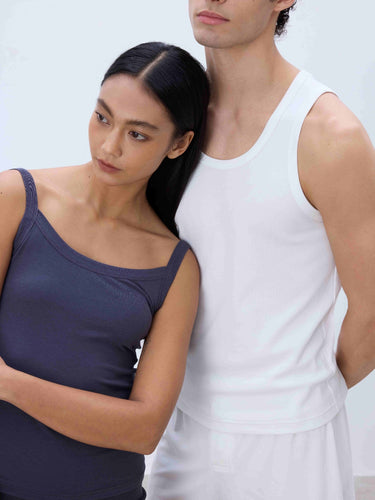
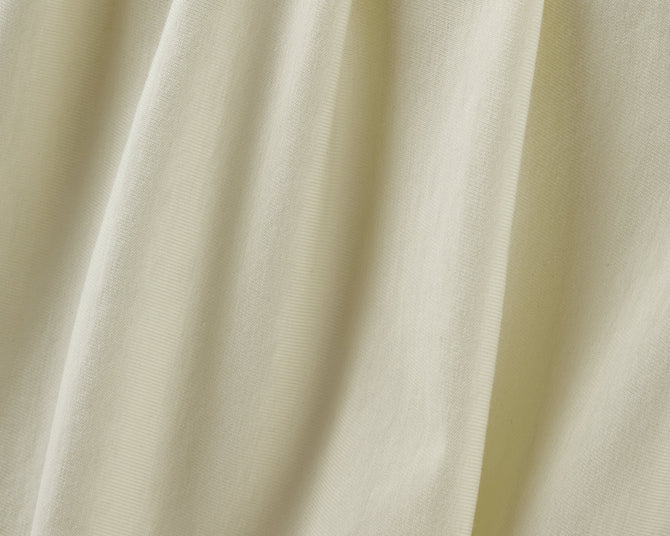




“Cooling” in fabrics is often treated like a single feature. In development work, it behaves more like a system: first-touch heat exchange, moisture / vapor transport, and how the knit structure manages humidity next to skin. That’s why two fabrics with similar fiber content can feel very different once GSM, yarn build, and finishing change.
In this article, cooling refers to perceived comfort via microclimate management (skin-side heat + humidity control). Chemical “cooling finishes” can exist, but they are a separate mechanism with different durability and test considerations.
What is a “cooling” fabric in technical terms?
A cooling fabric typically delivers a lower perceived temperature by combining faster initial heat transfer with better moisture/vapor management near skin. In most builds, the sensation depends more on structure and gsm than on fiber content alone.
The four pathways that shape “cool” handfeel and wear comfort
-
Conduction (first-touch coolness): how quickly heat leaves the skin at contact
-
Evaporation (sweat cooling): how efficiently liquid moisture spreads and dries
-
Convection (air exchange): how knit geometry and porosity move warm, humid air away
-
Radiation (IR exchange): typically secondary in everyday apparel, but relevant in some engineered systems
Why “cool to touch” and “cool to wear” don’t always match
A fabric can feel cool on contact and still feel humid after 20 minutes. The first is often dominated by surface contact + transient heat flow; the second is governed by vapor resistance, air permeability, and moisture buffering—all of which shift with stitch density, yarn bulk, and finishing.

How do common fibers compare for cooling comfort?
Fiber selection typically sets the baseline for moisture uptake and thermal comfort, while knit structure and finishing decide how consistently that baseline translates into wear. The right comparison is “fiber × structure × gsm,” because fiber alone rarely predicts the final feel.
Comparison table: TENCEL™/Merino blend vs 100% Merino vs 100% Lyocell
| Attribute (typical) | TENCEL™/Merino blend (knit) | 100% Merino (knit) | 100% Lyocell / TENCEL™ Lyocell (knit) |
| First-touch coolness | Medium–High (depends on surface + density) | Medium | High (often strong “cool touch” when compact) |
| Humidity buffering near skin | High (balanced) | High | Medium–High |
| Liquid sweat handling | Medium–High (structure-dependent) | Medium (can feel damp if build is dense) | High (spreads quickly in many builds) |
| Drying speed | Medium–High | Medium | High |
| Odor / comfort over long wear | Medium–High | High | Medium |
| Dimensional stability risk | Medium (depends on blend, yarn, finishing) | Medium–High (care + structure sensitive) | Medium (often stable, finishing-dependent) |
| Best-fit seasons | SS + transitional | Transitional + 4-season layering | SS + humid climates |
| Typical use cases | next-to-skin knits, city active, travel | baselayers, thermoregulation systems | tees, sleepwear, warm-weather knits |
Where TENCEL™/Lyocell and Merino contribute differently
-
Cellulosic fibers (Lyocell / TENCEL™ Lyocell): often chosen for moisture regulation and smooth handfeel, supporting a drier perceived microclimate in many summer-weight knits.
-
Authoritative reference: TENCEL™ Lyocell – Experience natural comfort
-
Merino wool: commonly used as a thermoregulation baseline because it can stabilize comfort across activity/rest cycles, particularly when humidity management is part of the system.
-
Authoritative reference: Merino wool proven to have superior thermoregulation
For a deeper baseline on wool’s temperature regulation behavior, see:
Internal reference: https://www.regentech-fashion.com/blogs/fabric-trends/merino-wool-temperature-regulation
How does cooling performance show up in real garments and seasons?
Cooling comfort typically matters most in SS and transitional seasons, where users move between outdoor heat, indoor air conditioning, and varying activity levels. In these scenarios, the fabric’s job is to keep the skin-side humidity stable and avoid a “clammy rebound.”
SS (warm + humid): prioritize moisture transport + low vapor resistance
In humid conditions, the limiting factor is often evaporation. Fabrics that spread moisture quickly but trap vapor can still feel hot. For SS development briefs, it’s usually more productive to specify targets for drying time, vapor resistance, and air permeability rather than relying on a single “cooling” claim.
Transitional (stop-go daily wear): aim for stability, not extremes
Transitional comfort often rewards builds that avoid spikes—too wet after a commute, too chilly after a stop. Blends and structures that buffer humidity and maintain stable handfeel tend to perform well here, especially for base-to-mid layer knits.
What “cooling tech” looks like at the fabric-construction level
Common levers (one or two usually do the heavy lifting):
-
Knit geometry: mesh/piqué / engineered zones to increase air exchange
-
Yarn strategy: filament vs spun, yarn bulk, twist, plating, differential yarn placement
-
Surface engineering: smoothness, contact points, micro-roughness, controlled brushing (when relevant)
-
Finishing: hydrophilic management, softeners, compacting, dimensional control, wash durability targets
Which specs and test data should sourcing teams request?
Cooling claims typically become useful when they are anchored to repeatable specs: gsm range, knit density, finishing recipe family, and measurable comfort proxies. In most B2B programs, sourcing teams achieve better outcomes by requesting test reports and bulk controls than by debating adjectives like “ice cool.”
A spec-first checklist for cooling programs (sampling → bulk)
Ask your fabric supplier for:
-
Fabric build definition: fiber %, yarn type, yarn count, stitch type, target density, gsm tolerance
-
Comfort testing: at least one heat/moisture method + one moisture management method
-
Durability: wash-cycle impact on handfeel and performance; pilling risk if relevant
-
Consistency controls: lot-to-lot shade + handfeel controls, finishing recipe lock, relaxation protocol
-
Use-case assumptions: intended end-use (tee, base layer, sleepwear), climate, layering expectation
Tests that map well to “cooling” as microclimate control
A practical set often includes:
-
Thermal resistance + water-vapor resistance (steady-state): supports microclimate framing, especially when comparing builds.
-
Authoritative reference: ISO 11092:2014 – Measurement of thermal and water-vapour resistance (sweating guarded hotplate)
-
Liquid moisture management (spread / one-way transport / drying behavior): helpful for SS and active-lifestyle briefs.
-
Authoritative reference: AATCC TM195 – Liquid Moisture Management Properties of Textile Fabrics
Commercial-intent keywords you should translate into specs
| If your internal request says… | Convert it into… |
| “cool touch” | surface feel target + gsm/density + contact-cooling proxy (method agreed with supplier) |
| “quick-dry” | drying time method + pass/fail window + after-wash re-test |
| “won’t feel clammy” | vapor resistance target + air permeability baseline + finishing durability |
If you’re comparing wool vs synthetics for natural performance framing, this internal reference can help structure the discussion:
Internal reference: https://www.regentech-fashion.com/blogs/fabric-trends/merino-wool-vs-polyester-natural-performance
Why do cooling claims fail in bulk production, and how do mills manage repeatability?
Most cooling disappointments in bulk happen because structure and finishing drift: density shifts, handfeel chemistry changes, or relaxation protocols vary. Repeatability typically improves when the program locks a narrow “process window” and treats cooling as a measured comfort profile, not a single label.
Common failure modes (and what to control)
-
GSM / density drift: changes air exchange and contact feel; even small shifts can move vapor resistance and “dry feel” noticeably.
-
Control: lock stitch density targets, define gsm tolerance (post-relax), and standardize conditioning time before testing.
-
Finishing variability (hydrophilic behavior): moisture management can swing when softener families, add-on %, or curing conditions change.
-
Control: lock the finish recipe family, specify add-on range, record curing temperature/time, and re-check performance after agreed wash cycles.
-
Relaxation protocol differences: results often differ between greige vs finished, pre-wash vs post-wash, and unrelaxed vs relaxed states.
-
Control: define a single protocol (conditioning, relaxation, wash method, dry method) and require supplier and brand labs to follow the same sequence.
-
Yarn-to-yarn variation: twist level, hairiness, blend uniformity, and spinning route can change surface contact, capillary pathways, and perceived clamminess.
-
Control: lock yarn specs (count, twist, CV% targets), qualify upstream yarn sources, and monitor key yarn parameters across lots.
-
Dyeing and auxiliary changes: salt/alkali profiles, dispersing agents, and pH control can affect handfeel and wetting behavior downstream.
-
Control: keep dyeing auxiliaries consistent for the program, document pH windows, and confirm no unintended hydrophobic residues remain.
-
Mechanical finishing drift: compacting, calendaring, sanding/peaching, and raising can shift surface contact area and pore structure.
-
Control: define machine settings windows (pressure/speed/temperature), measure thickness and density post-finish, and retain “golden sample” references.
-
Test method mismatch between labs: different instruments, specimen prep, or reporting formats can create false disagreements.
-
Control: align on the test method, specimen count, pre-conditioning, report template, and acceptance ranges; do a round-robin check early.
What “repeatability” looks like in a bulk-ready cooling program
Repeatability typically improves when cooling is treated as a measured comfort profile with a narrow process window:
-
Define the build: fiber %, yarn build, stitch type, target density, gsm tolerance
-
Define the finish: finish family + add-on range + curing window + after-wash expectation
-
Define the test plan: which method(s), which state (as received / relaxed / after wash), and which acceptance ranges
-
Define the QC checkpoints: where in production to measure gsm/density/thickness and when to re-test moisture behavior
A practical “process window” checklist sourcing teams can request
-
GSM tolerance (post-relax, conditioned), plus measurement method
-
Stitch density / width control and allowable drift
-
Finish recipe lock (softener family, hydrophilic system, add-on range)
-
Mechanical finish settings window (if used)
-
After-wash performance expectation (e.g., after 5 washes)
-
Golden sample + limit sample retained for handfeel reference
-
Lot-to-lot reporting (gsm, thickness, air permeability, moisture management proxy)
How Regen-tech Fashion manages repeatability in cooling programs
Repeatability typically improves when cooling is treated as a comfort profile within a narrow process window, rather than a single label. At Regen-tech Fashion, we lock the variables that move perceived cooling the most—construction definition, gsm/density window, finishing family, and a shared test state—before scaling beyond sampling.
A practical reference point is our contact-cooling direction (used on selected lyocell-led summer builds): the performance intent is defined up front, then held steady by controlling stitch density, post-relax gsm, and finish add-on / curing windows across lots. The goal is consistent microclimate behavior in wear, not a one-off “cool touch” in the lab.
In practice, we align on what “pass” means in the same condition (as received vs relaxed vs after wash), then control the inputs that typically cause drift in bulk—especially density/gsm, relaxation protocol, and moisture-management durability.
Conclusion: Cooling Comfort Works Best as a Measured Microclimate Profile
Cooling performance in textiles is most reliable when it’s defined as perceived-temperature control—the combination of first-touch heat exchange and long-wear humidity management near skin. Fiber choice sets a baseline, yet the final result usually comes from the build details: knit geometry, gsm/density, surface state, and the finishing window that holds those behaviors steady.
For sourcing and development teams, “cooling” becomes actionable once it’s translated into a spec + test state. Aligning on construction definition, post-relax gsm tolerance, and which condition counts as “pass” (as-received, relaxed, or after wash) prevents most late-stage disagreements and helps bulk match approved samples. Ready to build a consistent cooling program for your next SS collection? Contact us for a spec-first consultation.
Find Your Tencel Wool Fabric Solution with Regen-tech Fashion
Regen-tech Fashion supports brands with reliable Tencel Wool fabric sourcing, product development, and sample evaluation. Whether you are learning about Tencel Wool fabric, comparing product options, or looking for a production-ready supplier, you can continue exploring through the links below.
Understand the fiber composition, soft touch, thermal comfort, and application potential of Regen-tech Fashion’s Tencel Wool fabric series.
Browse available Tencel Wool fabric options and request samples for your next collection.
Find a focused sourcing solution for Tencel Wool fabric development, sampling, and supplier support.
Regen-tech Fashion — advancing textile performance through precision, comfort, and responsible innovation.
👉 Click here to learn about the TENCEL™ Merino Wool Series
📩 Contact: Marketing@regentech-fashion.com
Article Keywords:
Cooling Comfort Fabrics, Cooling Technology Textiles, Moisture Management Fabric, Fiber Performance Science, Functional Knit Fabrics, Knit Fabrics